Teen Patti
A three-card Indian game related to poker. Hands rank from Trail (three of a kind) down through Pure Sequence, Sequence, Colour and Pair to High Card. Live variants usually pit a Player hand against a Dealer hand.
Games
The Maxwinexch games area groups interactive titles into four categories. Searches for "maxwinexch casino" and "maxwinexch game" usually lead here.
Card-based titles familiar to Indian players, presented in the games area alongside the table titles.

A three-card Indian game related to poker. Hands rank from Trail (three of a kind) down through Pure Sequence, Sequence, Colour and Pair to High Card. Live variants usually pit a Player hand against a Dealer hand.
A middle "joker" card is shown, then cards are dealt alternately to Andar (inside) and Bahar (outside). The side that receives a card of the same rank first wins. Each deal is close to 50/50.
Classic table formats, including a compact Mini Roulette variant.

A ball lands on one of 37 numbers in European roulette (0–36). Outside bets such as red/black pay 1:1 at just under 50%; a single number pays 35:1. The single zero produces a house edge of about 2.7%.
A compact wheel with fewer pockets (commonly 13: 0–12). Payouts are scaled down, and fewer numbers make rounds faster. Check the paytable, as the house edge differs from standard roulette.
Bet on Player, Banker or Tie; the hand closest to 9 wins, with card values added and only the last digit counted. Drawing follows fixed rules. Banker wins slightly more often, so a commission (typically 5%) applies.
Beat the dealer by getting closer to 21 without going over. Basic strategy — the mathematically best decision for each hand — keeps the house edge low; side bets usually raise it.
Short-round titles built around simple choices and fast results.
Choose a target number and whether the roll lands over or under it. A lower probability of winning gives a higher payout, so the risk/reward trade-off is visible before each roll.
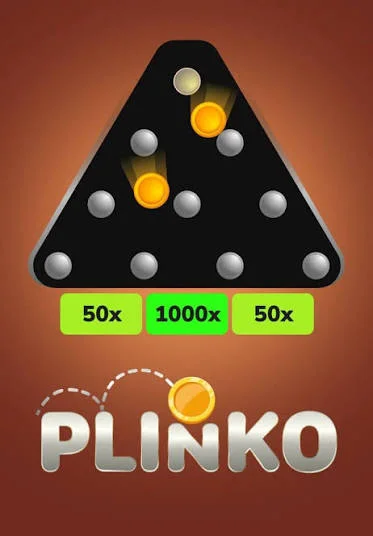
A ball drops through pegs into slots with different multipliers. Edge slots pay most but are reached least; many versions let you choose rows and risk level.
A step-by-step title where you advance across a field choosing safe cells. Each step raises the multiplier and the risk; you can collect at any step.
Guess whether the next card will be higher or lower than the current card. Odds and payouts shift with each card — a 2 or a King is far easier to call than a 7.
A grid hides mines. Reveal safe tiles to raise the multiplier and cash out before hitting a mine. More mines mean higher multipliers per tile and faster losses.
Pick numbers from a larger pool, after which a set of numbers is drawn. Payouts depend on how many picks match; matching all of many picks is rare and pays the most.
A round-based crash title where a multiplier rises until the round ends.

A crash title: the multiplier climbs until the plane flies away. Cash out before it ends to keep stake × multiplier. Rounds are independent.
Volatility describes how results are spread: low-volatility titles produce frequent, small outcomes; high-volatility titles produce rare, large ones. Neither changes the long-run house edge.
| Titles | Volatility | What to expect |
|---|---|---|
| Andar Bahar, Baccarat, Roulette (outside bets) | Low | Frequent, small outcomes close to even money |
| Blackjack, Teen Patti, Hi Lo | Low–medium | Decisions influence results within fixed odds |
| Dice, Mines, Goal, Plinko | Adjustable | You choose the risk level per round |
| Keno, Roulette (single numbers), Aviator (high targets) | High | Rare large outcomes, long losing runs |
The percentage of total stakes a title returns over a very large number of rounds. An RTP of 97% means a 3% house edge in the long run — individual sessions will vary widely.
The built-in mathematical advantage of every game. It is why no betting system or pattern can produce reliable long-term profit.
Digital titles determine results with random number generators; some crash and quick games add provably fair verification so you can check a result after the round.
Live-dealer versions of card and table games use real cards or wheels on camera; digital versions use RNG. Rules are the same, but round speed differs.